Billion Dollar Blind Spot in Supply Chain Security
How third-party mobile app SDKs quietly turned convenience into a global supply chain security risk.
The modern mobile app economy is built on speed. Developers are under constant pressure to ship features faster, monetize sooner, and compete in overcrowded app stores. To meet these demands, they rely heavily on third-party Software Development Kits (SDKs) prebuilt components that provide analytics, advertising, authentication, payments, crash reporting, and more.
What began as a convenience has quietly evolved into something much larger: a billion-dollar industry fueled by supply chain security blind spots in mobile applications. Today, thousands of third-party SDK vendors operate deep inside mobile apps, collecting data, monetizing user behavior, and shaping the economics of the mobile ecosystem often beyond the visibility or control of the app developers themselves.
The Rise of the Mobile SDK Economy
Mobile SDKs were originally designed to solve practical problems. Instead of every developer building their own analytics engine or ad network integration, SDK providers offered reusable solutions that “just worked.” Over time, entire categories of SDKs emerged:
- Advertising and monetization SDKs
- User analytics and behavior tracking SDKs
- Attribution and marketing performance SDKs
- Social media and identity SDKs
- User engagement and notification SDKs
Today, a single popular mobile app may embed 20–40 third-party SDKs, each developed and maintained by a different vendor. Many of these vendors generate revenue by collecting, analyzing, and monetizing user data at massive scale.
The result? A sprawling mobile data economy worth billions, built not through direct relationships with users, but through deep integration into app supply chains.
Where Supply Chain Security Fell Behind
In traditional enterprise software, supply chain security has long been a concern. Dependencies are reviewed, source code is scanned, and vendors are assessed. Mobile development, however, evolved differently.
Several structural factors created the perfect conditions for SDK-driven data businesses to thrive:
1. Limited Visibility into SDK Behavior
Mobile SDKs are often shipped as compiled or obfuscated binaries. Developers integrate them via package managers with minimal insight into what the SDK actually does at runtime. Network calls, data collection logic, and downstream sharing are largely hidden.
In effect, developers trust the SDK by default, granting it the same privileges as first-party app code.
2. Permission Inheritance
Once an app is granted a permission such as location, camera, contacts and device identifiers every embedded SDK inherits that access. This means an advertising or analytics SDK can collect sensitive data without explicitly asking the user for permission itself.
This architectural choice made data access cheap and scalable for SDK providers.
3. Lack of Runtime Governance
Historically, mobile platforms focused on app-level review rather than component-level behavior. App store reviews evaluate the app as a whole, not the dozens of third-party SDKs embedded within it. This left a governance gap where SDK behavior could evolve unnoticed over time.
4. Rapid, Automatic Updates
SDKs update frequently. A developer might integrate an SDK for basic analytics, only to find months later that the same SDK now includes cross-app tracking, fingerprinting, or new data-sharing relationships, all without code changes in the app itself.
From Utility to Stealing Data for Fun & Profit
As SDK adoption exploded, many vendors realized something powerful: they didn’t need to own the app to own the data. This is why there are currently 7.4 million mobile SDKs available to iOS & Android developers; however, only 4 million mobile apps in the App & Play Store (combined).
By embedding SDKs across thousands of apps, vendors could aggregate data across:
- Devices
- Apps
- Geographies
- User behaviors
- Purchase patterns
- Location histories
What started as “analytics” evolved into profiling, attribution modeling, ad targeting, and behavioral prediction. Data collected from SDKs became more valuable than the SDKs themselves.
This shift transformed SDK providers into data brokers, ad tech platforms, and intelligence engines, often operating far downstream from the app developer’s original intent.
The mobile supply chain didn’t just enable this transformation, it accelerated it.
The Billion-Dollar Feedback Loop
The economics of third-party SDKs created a powerful feedback loop:
- Developers want free or low-cost tools
- SDK vendors monetize through data
- More data improves targeting and insights
- Better targeting increases revenue
- Revenue funds wider SDK distribution
Because SDKs were “free,” developers rarely questioned the true cost: user data and trust. Meanwhile, SDK vendors scaled rapidly, embedding themselves into millions of devices worldwide.
Today, some SDK companies influence data flows across hundreds of millions or even billions of users, despite having no direct relationship with them.
Why This Is a Supply Chain Security Crisis
The success of third-party SDKs highlights a fundamental truth: supply chain security is not just about preventing attacks, it’s about controlling behavior.
Mobile SDK risks include:
- Unintended data exfiltration
- Regulatory exposure under GDPR, CCPA, and similar laws (See Figure 1)
- Shadow data sharing with unknown downstream partners
- Increased attack surface through opaque dependencies
- Loss of user trust when data practices are exposed
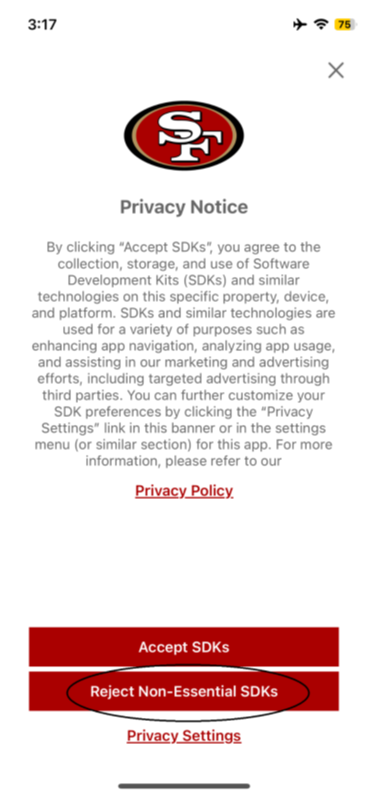
Figure 1: Users in the EU are now warned about 3rd Party SDK (Supply Chain Issues), but the rest of the world is still vulnerable.
Why the Problem Persisted for So Long
If the risks are so severe, why did this ecosystem go largely unchecked for years?
- Developers optimized for speed and growth
- App stores lacked granular enforcement
- Users had little visibility into SDK-level behavior
- Regulation lagged behind technical reality
Most importantly, responsibility was diffused. SDK vendors claimed developers were responsible for disclosures. Developers assumed SDKs were compliant. Platforms focused on user-facing UX rather than backend data flows.
The result was a massive accountability gap and an industry that thrived within it.
A Turning Point for Mobile Supply Chain Security
The tide is now starting to shift.
- Regulators are scrutinizing third-party data flows
- See figure 1 from the San Francisco 49ers App used in Paris, France, but would not be shown to any users in San Francisco, CA
- Platform providers are tightening privacy controls.
- Enterprises are demanding stronger software supply chain assurances.
- Security teams are treating mobile dependencies as first-class risks.
New categories of tooling such as mobile runtime protection, SDK behavior analysis, and continuous supply chain monitoring are emerging to close the visibility gap that allowed unchecked SDK growth.
Conclusion: Lessons from a Billion-Dollar Blind Spot
The third-party SDK economy didn’t become a billion-dollar industry by accident. It grew because mobile supply chain security was never designed to handle embedded, data-hungry, continuously evolving components operating at global scale.
This isn’t just a cautionary tale about privacy it’s a broader lesson about modern software development. When visibility, governance, and accountability lag behind innovation, entire industries can emerge in the shadows.
As mobile apps continue to power banking, healthcare, transportation, and government services, securing the mobile supply chain is no longer optional. The same mechanisms that enabled explosive growth can, if left unchecked, undermine trust at the core of the digital economy. The next chapter of mobile innovation will belong to organizations that understand one simple truth: You don’t just ship an app, you ship its entire supply chain.