Why APIs Are the Main Target
APIs carry the data behind every mobile app, web app, partner integration and AI agent. They are built and changed quickly, often by many teams, and each change can expose data that was protected yesterday. The most damaging API flaws are not exotic. They are authorization mistakes: one user's token that can read another user's records, or a regular account that can call an admin function.
Attackers also find APIs that security teams do not know about. Shadow APIs, forgotten versions and test endpoints left in production are reachable from the internet and rarely tested.
What API Security Testing Should Cover
- Broken object level authorization (BOLA).Can a user access objects that belong to someone else by changing an ID?
- Broken function level authorization and privilege escalation.Can a low-privilege user call functions meant for admins?
- Authentication weaknesses.Weak token handling, missing authentication on sensitive endpoints, and session flaws.
- Excessive data exposure.Responses that return more data than the client needs.
- Injection and input handling.Classic injection flaws still appear in API parameters.
- Encryption and transport.Endpoints that allow weak or missing encryption.
- Configuration drift.An API that was protected and is no longer protected after a change.
These map closely to the OWASP API Security Top 10, which is a good baseline for any program.
Why Authenticated Testing Matters
Unauthenticated scans only see the outside of an API. Most serious flaws live behind the login, where the logic decides who can see what. Testing BOLA or privilege escalation requires the tester to hold real sessions for different users and compare what each can reach. That is why authenticated, session-aware testing finds the issues that lead to real data breaches.
Start With Discovery
You cannot test an API you do not know exists. Integration-based discovery (cloud accounts, API gateways, code repositories) finds the APIs you already know about. Attackers look further: they probe your domains and pull API calls straight out of your mobile and web apps. A complete testing program discovers APIs the same way, so shadow and zombie APIs get tested too.
Make Testing Continuous
APIs change weekly or daily. A quarterly penetration test sees a snapshot. Continuous API security testing runs whenever an API is added or changed, and alerts when an API that was protected starts leaking data.
How Data Theorem API Secure Tests APIs
Data Theorem API Secure covers the full lifecycle in four pillars: discover, posture, security testing and runtime protection.
- Discovery from cloud accounts, gateways, integrations and code repositories, plus black-box probing of your perimeter and reverse engineering of your mobile and web apps to find APIs integrations miss, including ones that point to unknown cloud environments.
- Fully authenticated security testing using your identity provider integration to maintain sessions, covering BOLA, privilege escalation and custom DAST checks across REST, GraphQL, gRPC, SOAP and serverless APIs.
- Leaky API alerts when a previously protected API changes and is no longer protected.
- AI Exploits chains individual findings into the attack path an attacker would take, so teams fix the chain, not a long list.
- SAST+ correlation links verified findings back to the code through Code SAST Secure.
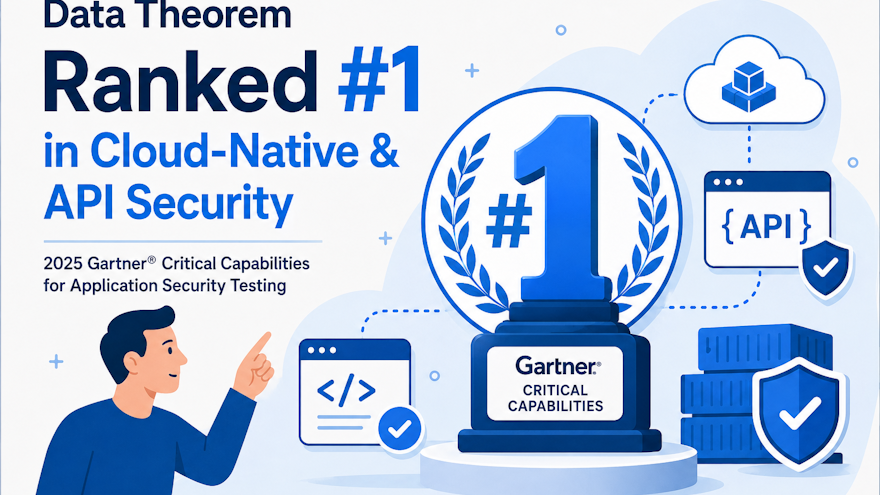
Data Theorem was top ranked for API security in the 2025 Gartner® Critical Capabilities for Application Security Testing.
API SecureDiscover, posture, security testing and runtime protection.Learn MoreRelated Data SheetAPI Secure Data SheetDiscover, harden, test, and protect every API across mobile, web, and cloud. API Secure is Data Theorem's full-lifecycle API security platform: it continuously inventories every REST, GraphQL, gRPC, SOAP, and serverless API, hardens posture across multi-cloud, attacks them with hacker-style testing, and defends against prompt injection, LLM abuse, and AI-augmented attacks at runtime. Download the datasheet to see how discovery, health, testing, and active protection come together in one platform.Read Now
Frequently Asked Questions
What Is the Difference Between API Security Testing and API Penetration Testing?
A penetration test is a point-in-time manual assessment. API security testing can be automated and continuous, running every time an API changes. Most programs use both.
Can API Security Testing Find Shadow APIs?
Testing finds flaws in the APIs it knows about. Pair it with discovery that probes your perimeter and your apps so shadow APIs are found and then tested.
What Is BOLA?
Broken object level authorization: an API returns an object, such as an account record, without checking that the caller is allowed to see it.
How Often Should APIs Be Tested?
Every time they change. For most teams that means continuous testing.
Source: Gartner, Critical Capabilities for Application Security Testing, Mark Horvath, Jason Gross, Aaron Lord, Shailendra Upadhyay, 13 October 2025. Gartner is a registered trademark and service mark of Gartner, Inc. and/or its affiliates in the U.S. and internationally and is used herein with permission. All rights reserved. Gartner does not endorse any vendor, product, or service depicted in its research publications and does not advise technology users to select only those vendors with the highest ratings or other designation. Gartner research publications consist of the opinions of Gartner's research organization and should not be construed as statements of fact. Gartner disclaims all warranties, expressed or implied, with respect to this research, including any warranties of merchantability or fitness for a particular purpose.
See API Secure