Why Mobile Testing Is Different
A mobile app ships as a binary to devices you do not control. Anyone can download it and take it apart. It bundles third-party SDKs your developers did not write, stores data on the device, and talks to backend APIs that are often the real target. Apple and Google also enforce their own rules, and an app that breaks them can be blocked from updating. A mobile testing program has to cover all of that, release after release.
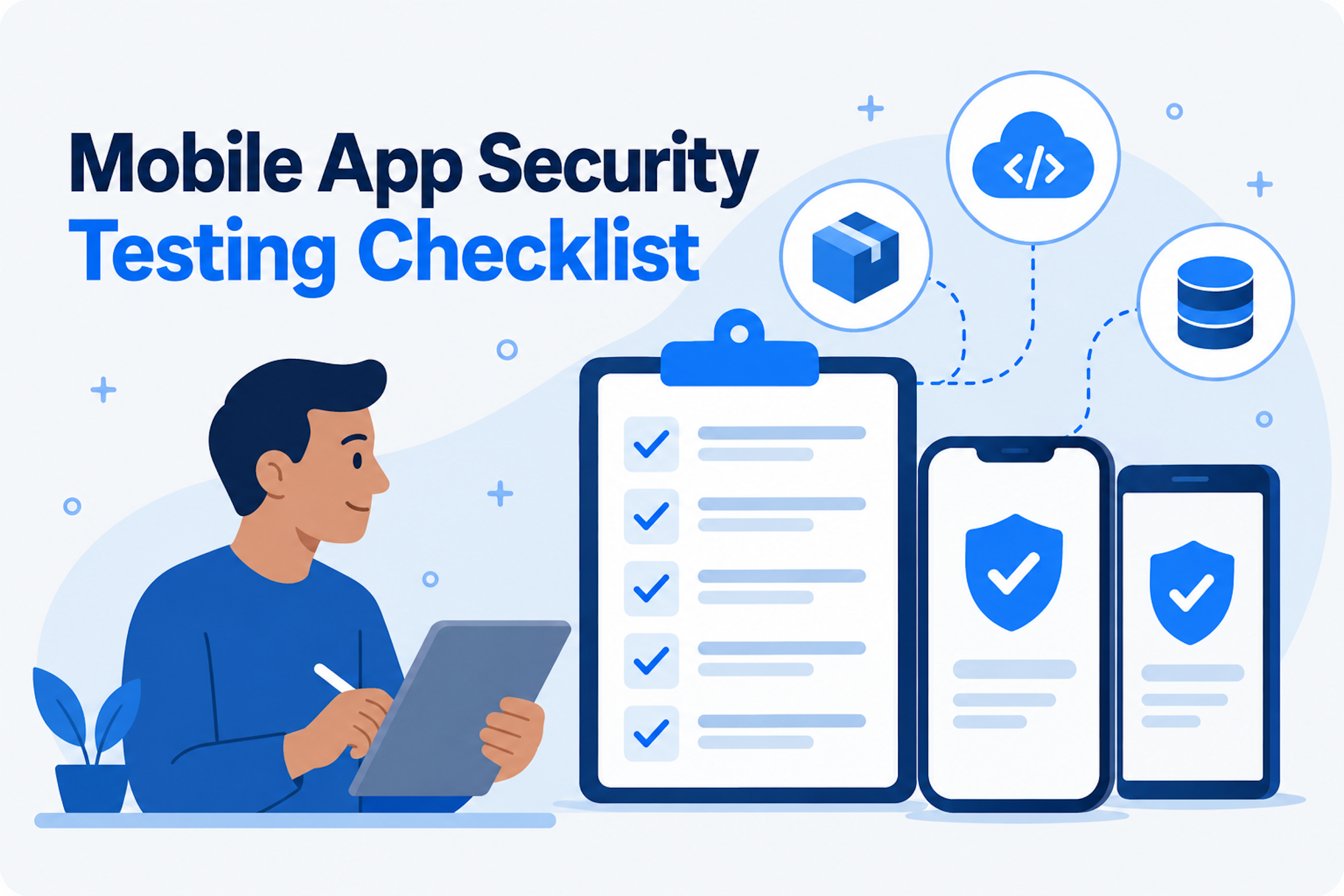
The Checklist
Data storage and privacy
- Sensitive data is not stored on the device unencrypted.
- Platform protections such as iOS Data Protection are actually enabled, not just configured.
- Secrets, tokens and credentials are not hardcoded or written to logs.
- You know what personal data the app collects and which third parties receive it.
Network and communication
- All traffic uses strong encryption, with no cleartext fallbacks.
- Certificate validation is enforced; consider SSL pinning for sensitive apps.
- You know which countries the app's traffic is routed through.
Authentication and sessions
- Session tokens are stored securely and expire properly.
- Authentication flows cannot be bypassed through deep links or exported components.
Backend APIs
- Every API the app calls is inventoried, including undocumented ones.
- APIs enforce authorization on every object and function (no BOLA).
Third-party code
- Every embedded SDK and open source library is in an SBOM with known vulnerabilities attached.
- SDK data collection matches your privacy disclosures.
Platform and store requirements
- Known App Store and Google Play blockers are checked before submission.
- The app supports the latest iOS and Android versions on day one.
Code and build
- Source code is scanned with SAST, including Swift and Kotlin specific checks.
- Findings are prioritized by exploitability, not just severity.
- The binary is hardened against reverse engineering for apps that need it.
Process
- Testing runs automatically on every release, not once a quarter.
- Fixes reach developers with clear remediation guidance.
- Runtime protection defends the app while fixes are pending.
Automate It, Release by Release
Manual checklists do not scale to weekly releases. Automated mobile application security testing runs the same checks on every build, so nothing slips between releases. It should run against real devices without requiring jailbroken or rooted phones, which also means the newest OS versions are supported from day one.
How Data Theorem Mobile Secure Covers the Checklist
Data Theorem was founded in 2013 with a focus on mobile application security, and Mobile Secure is its longest-running product.
- Automated, fully authenticated binary scans of every iOS and Android release, with no jailbroken or rooted devices required and day-one support for new OS versions.
- SAST, DAST, forced-path execution and privacy analysis, covering the OWASP Mobile Top 10 in full and the OWASP mobile testing guide (MSTG).
- Privacy findings on what data the app collects, what it shares with third parties, what it stores unencrypted and what it sends to backend APIs.
- A complete SBOM of embedded SDKs and open source libraries, with findings attached.
- App Store blocker detection, a capability Data Theorem has maintained for over 13 years.
- AI Exploits chains mobile findings into the exploit path an attacker would take, and AI Auto-Remediation sends fixes to your code through Code SAST Secure.
Pair it with Mobile Protect to defend the app at runtime while fixes ship.
Mobile SecureAutomated, fully authenticated binary scans of every iOS and Android release.Learn MoreRelated Data SheetMobile Secure Data SheetContinuous mobile app security testing for iOS and Android, on every release. This two-page overview covers how Mobile Secure combines static, dynamic, and behavioral analysis on real devices with third-party SDK review, auto-triaged alerts to Slack, Teams, or email, and secure-code remediation that closes findings in days. Includes supported frameworks, compliance coverage (PCI DSS, HIPAA, GDPR, SOC 2, and more), and CI/CD integration details.Read Now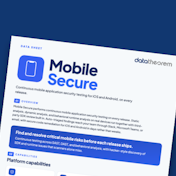
Frequently Asked Questions
What Is Mobile Application Security Testing?
Testing an iOS or Android app for vulnerabilities and privacy issues, covering the binary, its data storage, its network traffic, its SDKs and the APIs it calls.
What Is the OWASP Mobile Top 10?
A list of the most critical security risks for mobile apps, maintained by OWASP. It is a common baseline for mobile testing.
Do I Need a Jailbroken Device to Test My App?
Not with modern automated testing. Avoiding jailbroken devices also means testing works on the newest OS versions immediately.
How Often Should Mobile Apps Be Tested?
On every release.